
There is a version of building knowledge you get from studying, and a version you only get from working in one place for a long time...
The second kind is harder to come by, and it shows up in ways that are not always obvious until something goes wrong.
Hobart is also not a generic building environment - as we all know, the homes here have particular histories, the land has particular conditions, and the climate puts specific pressure on materials and methods.
A builder who has spent years working across Sandy Bay, Mount Nelson, West Hobart and Glenorchy learns things about these homes that no textbook covers. Tom and Zak from Nomac Built have that kind of knowledge. This post is their attempt to share some of it....
If you are considering a renovation or new build in Hobart and want to understand why local experience matters, this is worth reading before you start talking to anyone. See how Nomac Built approaches custom home builds in Hobart.
Tasmania has a colder climate than the mainland, and Hobart homes built before 1990 were largely constructed without the insulation standards that are now mandatory. This is one of the most consistent and costly surprises homeowners encounter during home renovations in Hobart.
Older homes in this era were often built with little or no wall insulation and minimal ceiling insulation. The assumption was that masonry or double-skin weatherboards provided sufficient thermal mass. In practice, Hobart winters exposed the limits of this approach, and many homeowners have been managing cold, draughty interiors for years without understanding why.
When a renovation opens walls and ceilings, the question of insulation upgrading becomes unavoidable. This is where local knowledge genuinely changes outcomes. Zak has found that the decision about which insulation system to use in a Tasmanian home is not one-size-fits-all.
"We always look at the vapour management side of things carefully here, because Hobart's climate is genuinely different to Brisbane or even Melbourne," Zak says. "Get the vapour barrier wrong in a Hobart home and you create a condensation problem that shows up two winters later. We have seen that happen on jobs where someone used a mainland spec without adjusting for local conditions. It is a fixable problem, but an expensive one."
Most of the renovation work in Hobart involves homes built before 1980. These homes have a particular character, and what you find inside the walls is rarely what the outside suggests. Understanding what is common in this era of construction is one of the most practical things a local builder brings to an assessment.
"You get to a point where you stop being surprised by what's in these walls," Tom says.
"But you never stop checking. We had a job in West Hobart last year where the owner thought it was a straightforward kitchen extension. Once we opened the rear wall, we found the original footings just stopped about 600mm short of where the new load was going."
"That kind of thing adds cost and time, but it is a lot better to find it before you pour concrete than after."
Hobart's geography is one of the defining factors in how building work is planned and priced here. The city sits between the Derwent and the foothills of kunanyi, and a significant proportion of its residential land is on slopes that would be considered challenging in most other Australian cities.
Sloping blocks in suburbs like Mount Nelson, Taroona and parts of Lenah Valley require a different approach to site preparation, drainage, and structural design. What looks straightforward from the street can involve significant earthworks once a site is assessed properly. Split-level designs that seem like an aesthetic choice are often a practical response to grades that make a single-level build impractical or prohibitively expensive.
Retaining and drainage design:
Sloped sites require engineered retaining walls that are sized for the specific soil load and drainage flow, not a generic specification. In Hobart, clay-based soils on steeper blocks can move seasonally, and a retaining system that ignores this will show movement within a few years.
Access constraints:
Many Hobart properties in elevated suburbs have limited or difficult vehicle access. This affects how materials are delivered, where concrete trucks can reach, and in some cases whether certain construction methods are even viable. These are things that come up in the planning phase, not as surprises mid-build.
Engineered footings on variable ground:
Fill sites and cut-and-fill blocks, which are common in Hobart's hillside suburbs, often require footing systems that go well beyond a standard slab. A builder who has not worked extensively on Hobart terrain may spec a footing system that is adequate on paper but not suited to the specific ground conditions of a given site.
Wind and weather exposure:
Higher elevation properties in Hobart face meaningfully different wind and weather loads than lower-lying areas. This affects roofing specification, cladding choice, and window and door detailing in ways that a mainland builder applying a standard spec would not necessarily account for.
Working through a renovation or new build on a challenging Hobart site? Tom and Zak are happy to walk you through what to expect before you commit to anything. Get in touch with the Nomac Built team and you will hear back directly from one of them.
A significant number of Hobart's residential properties fall within heritage overlay areas or sit close enough to listed properties that council requirements become a consideration in any significant renovation. Understanding how this works in practice, rather than in theory, is something that only comes from having navigated it repeatedly.
The practical reality is that heritage overlays do not prevent renovation or extension. What they do is shape how that work is designed and documented. A homeowner who engages a builder without local heritage experience often finds themselves going back to the drawing board on design elements that were always going to be a problem, costing time and money before a single piece of timber is touched.
According to Tom, the most common mistake he sees is homeowners not understanding what triggers a heritage referral. "People assume heritage only applies if the house itself is listed, but that is not how it works in Hobart," Tom says.
"You can be in a precinct where the streetscape is what is protected, and that changes what you can do to a front elevation even if your specific property has no individual listing. We walk clients through this before they get too attached to a design that is not going to get through council."
If you want to understand what applies to your property, the Hobart City Council heritage planning guidelines are a useful starting point.
Choosing materials for a Hobart home is not the same exercise as choosing materials for a build in a drier, warmer climate. The combination of cold winters, significant rainfall, and UV exposure in summer creates conditions that test materials in ways that a mainland specification will not always account for.
Zak keeps a fairly clear view on this from years of seeing how different material choices age. "We did a job a few years back where we were extending a home in Glenorchy and the owner had found a cladding product online that looked great and had a good warranty.
The warranty was valid, but the product was not designed for the level of moisture exposure you get in southern Tasmania," Zak says.
"We flagged it early and suggested an alternative, the owner came around when we showed them the manufacturer's climate zone data. That kind of conversation is one we have regularly."
Every section of this post covers a different facet of the same idea - that building knowledge is not just technical, it is geographical.
The way Hobart homes were constructed, the way it's ground behaves, the way it's climate moves through materials - these are things you learn by working in one place for long enough to see the consequences of decisions made years earlier.
Tom and Zak have been doing exactly that across Sandy Bay, West Hobart, Mount Nelson, Glenorchy and the suburbs in between for over a decade each. That means they walk into an assessment with a mental library of what these homes typically contain, what the ground in a given suburb tends to do, and what the council is likely to ask about. It does not mean every job is predictable, it means the unpredictable parts get handled faster and with less disruption because the context is already there.
That is the practical value of local experience. Not a marketing line, just what it means in practice when something unexpected turns up behind a wall at 8am on a Tuesday.
These are the questions Tom and Zak hear most often from homeowners who are weighing up a renovation or new build in Hobart. The answers are grounded in what they see on the ground regularly, not theory, but the practical reality of working on Tasmanian homes day to day.
Does local builder experience really make a difference to the outcome of my renovation?
Yes, and the difference tends to show up most in the planning and assessment phase rather than the build itself. A builder who knows Hobart's soil conditions, heritage rules, and construction history can identify issues and opportunities before they become costly surprises mid-project.
How do pre-1980 Hobart homes compare to newer builds in terms of renovation complexity?
They are generally more complex, because the construction methods and materials used before 1980 vary significantly and are not always documented accurately. Asbestos, outdated wiring configurations, non-standard framing, and absent insulation are common findings in this era of Hobart home, and each one needs to be managed correctly before other work can proceed.
What should I ask a builder to confirm they understand Hobart's specific conditions?
Ask them directly about soil conditions in the suburb your property is in, what heritage triggers apply to your site, and how they handle the discovery of unexpected materials or structural issues during a renovation. A builder with genuine local experience will answer these questions with specific examples, not generalities.
Is it worth upgrading insulation during a renovation even if it was not the original reason for the project?
In most Hobart homes built before 1990, the answer is yes. Once walls and ceilings are open, the cost of upgrading insulation is relatively low compared to the performance improvement you get year-round. Doing it later means reopening finished surfaces, which costs significantly more.
What Tom and Zak bring to every job is not just trade skill. It is familiarity with a specific place, the way its homes were built, the way its ground behaves, the way it's weather moves through materials over time. That knowledge does not transfer from a different city or a different climate. It accumulates through years of working in one place and paying attention to what you find.
If you are considering a renovation, extension or new build in Hobart and want to talk to builders who know this city from the inside out, Nomac Built is worth a conversation. Get in touch with Tom or Zak, the same people who will quote and deliver your project.

August 31, 2026
Comparing builder quotes in Hobart? Here's how tools like ChatGPT and Claude can help you understand the fine print and compare like for like.
read full post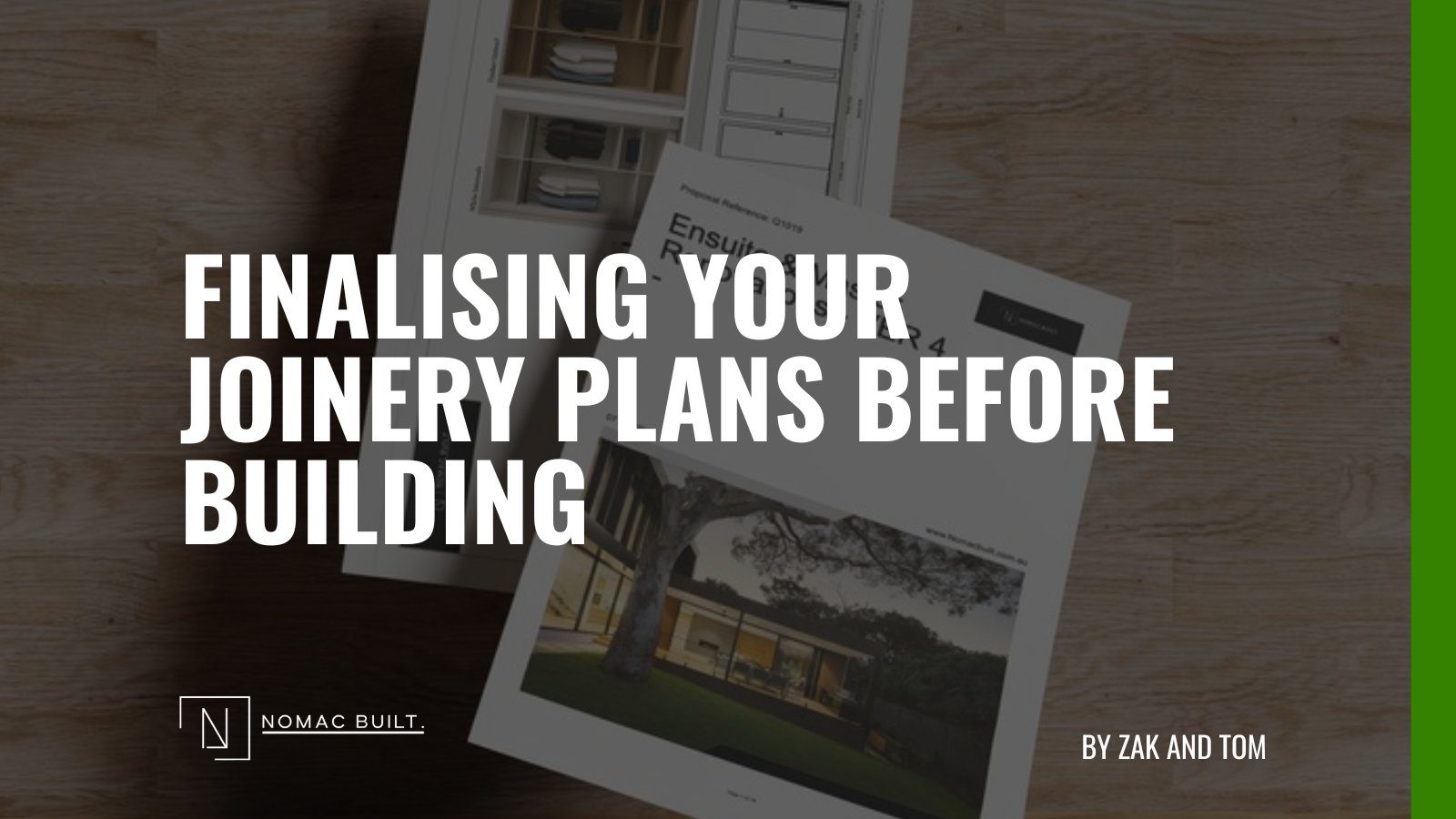
August 24, 2026
Renovating or building in Hobart? Finalising your joinery plans before the rough-in stage avoids costly rework and keeps your project on track. Here's why it matters.
read full post
July 27, 2026
Wondering how long a bathroom renovation takes? Here's a realistic Hobart timeline, common causes of delays, and how to keep your project on track.
read full post
July 2, 2026
Staying in your home during a renovation? Learn how to plan a live-in renovation in Hobart that stays liveable, safe and on track from start to finish.
read full post
June 22, 2026
Wondering how much a home extension costs in Hobart in 2026? This guide covers cost ranges, price drivers across suburbs, and budget planning tips.
read full post
May 27, 2026
Trying to decide between renovating or rebuilding in Hobart? Compare costs, site factors and long-term value to help you choose with confidence.
read full post
